Key questions
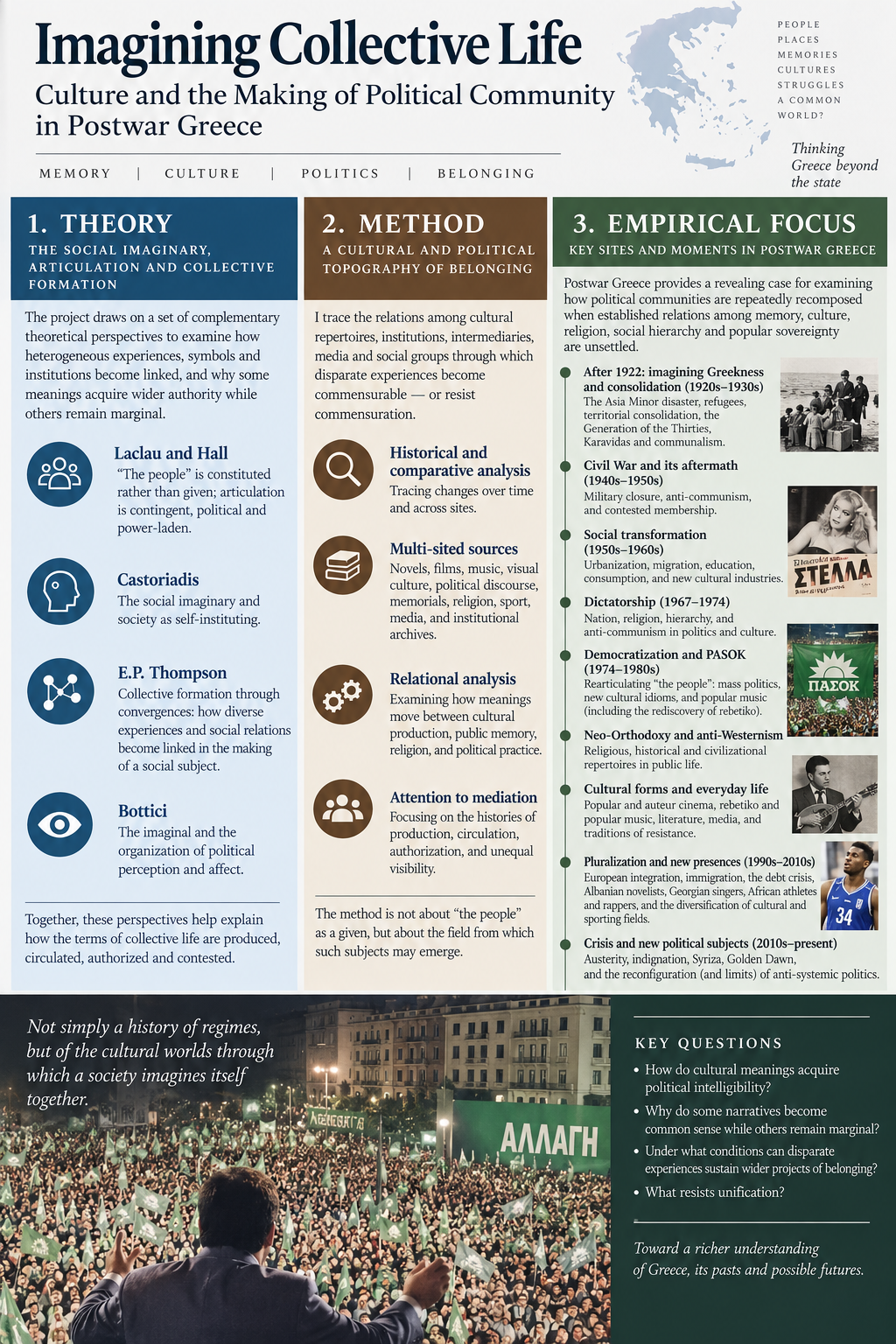
Postwar Greece offers a history not simply of successive political regimes but of repeated attempts to redefine the terms on which a society could imagine itself as sharing a common world. Civil war and exclusion, urbanization and migration, dictatorship and democratization, European integration, and the sovereign debt crisis altered not only institutions but the narratives, moral classifications, expectations, and structures of recognition through which belonging and collective obligation became intelligible.
The project asks how such transformations acquire cultural and political intelligibility, and how this shapes the field within which explicit political programs and claims to represent “the people” become possible. Rather than beginning with constituted identities or claims made in the name of “the people,” I examine the field within which such claims become plausible. How do memories of injury and achievement, ideas of dignity and justice, religious and national narratives, and experiences of social change acquire relations to one another across cultural forms, institutions, and publics? Why do some meanings become sedimented as common sense while others remain marginal or lose authority? Under what conditions can disparate experiences be rendered commensurable enough to sustain wider projects of belonging, and what resists such unification? Instead of merely focusing on political articulation – what Greeks at different moments believed themselves to share – the project explores the historical production of the terms through which commonality itself becomes imaginable – how the available terms for imagining it were themselves produced, circulated, authorized, contested, and displaced.
I use “collective life” to designate this historically variable field of possible commonality: the ways in which persons come to imagine themselves as inhabiting a shared social and political world. It encompasses not only explicit representations of community but assumptions about obligation, justice, sacrifice, historical continuity, social worth, and legitimate difference. Novels, films, songs, modes of remembering and commemorating, and political languages participate in producing these meanings, but always through institutions, industries, associations, intellectual networks, and social relations. Their political significance therefore lies not in textual content alone but in histories of production, mediation, circulation, and unequal visibility.
The project departs from accounts that treat political articulation as the primary explanatory moment. Retaining Laclau’s insistence that “the people” is constituted rather than socially given, I ask why some elements become available for articulation, why some combinations appear intelligible or affectively compelling, and why others do not. Castoriadis’s account of the social imaginary and society as self-instituting makes it possible to address this prior problem more radically; Hall foregrounds the contingency and power-laden character of articulation; Thompson shows how collective actors emerge from inherited social relations; Bottici directs attention to the imaginal and the organization of political perception and affect. What unites these traditions is a refusal to treat collectivities as either sociological givens or discursive effects detached from the histories that make them possible.
Project background
Postwar Greece constitutes fertile ground for this inquiry because it exposes the gap between formal political settlement and the more difficult institution of a shared political world. Building on Gourgouris’s account of modern Greece and Greekness as a culturally instituted national imaginary, I examine the recurrent struggles through which its contents, exclusions, temporalities, and claims to authority were reworked. My earlier work in Tormented by History, analyzed Greek and Turkish nationalisms through mutually implicated histories and competing regimes of memory. Whereas that book focused on the constitution of national identities through historical narratives and mnemonic regimes, the present project moves further back into the processes through which the cultural and social materials available for such constructions are produced, mediated, and transformed.
This question emerges from, rather than against, a substantial body of scholarship on postwar Greece. Work by Gourgouris and Demertzis, Panagiotopoulos and Vamvakas, Papadimitriou, Kornetis, Voglis, and others has produced rich accounts of political culture, collective imaginaries, memory, social transformation, religion, film, popular culture, and the cultural politics of dictatorship and democratization, often with considerable sensitivity to the intersections among these domains. What remains less systematically reconstructed is how these different sites and repertoires interacted over time: how meanings moved among cultural production, public memory, religious and civilizational idioms, political language, institutions, and social experience, and how those changing relations shaped the terms in which political community could be imagined. The project brings these processes into a single historical inquiry into the changing forms of collective life across successive postwar conjunctures. Its concern is not with culture as a mediating layer between pre-existing experience and politics, but with the relations through which social experience itself becomes intelligible, narratable, publicly recognizable, and politically available. I trace how particular understandings of belonging, injury, dignity, historical legitimacy, and common life are produced, circulated, authorized, reworked, or displaced, and how some acquire the capacity to sustain claims about who belongs, whose past counts, and what forms of collective life appear possible.
The postwar period can therefore be read as a succession of reconfigurations in the terms of collective life. The Civil War ended in 1949 with military and institutional closure but without resolving political membership. Anti-communism beyond a state ideology became a criterion through which political trustworthiness, historical memory, and full national belonging were differentiated. At stake was whose past could count as national history, whose suffering could acquire recognition, and whose political presence could appear legitimate. The 1950s and 1960s progressively unsettled this order. Migration, urbanization, expanding consumption, educational change, new cultural industries, and social mobility created publics increasingly difficult to contain within the inherited moral and symbolic architecture of the post-Civil War state. Popular culture supplied languages through which displacement, aspiration, class mobility, gender, modernity, and social injustice could be rendered intelligible. The dictatorship of 1967–74 attempted to arrest these dislocations by reinscribing authority within an intensified vocabulary of nation, religion, hierarchy, and anti-communism. Yet it operated within an already transformed cultural field, seeking both to discipline popular culture and to appropriate forms of popular authenticity through which it could represent itself as an expression of the nation.
After 1974, democratization reorganized the mnemonic and moral economy of political membership. Previously marginalized experiences entered public narration; the Left acquired political and retrospective legitimacy; resistance to dictatorship became central to democratic self-understanding; and languages of popular sovereignty, redistribution, recognition, and historical redress altered the terms of political community. PASOK was especially consequential as a moment in which heterogeneous memories, grievances, aspirations, and cultural idioms were rearticulated into a new representation of “the people.” The work of Panagiotopoulos and Vamvakas on Greece in the 1980s treats the decade as a dense field of interconnected social, political, and cultural transformation. The same period also produced alternative attempts to re-found collective life. The neo-Orthodox current of the 1980s is revealing in this respect. Intellectuals such as Yannaras and a wider dialogue among Orthodox, left-wing, and anti-Western intellectuals, sought to recover Orthodoxy not simply as religious inheritance but as the basis of an alternative sociality, relational and communitarian, grounded in a historical imagination of Hellenism distinct from the trajectories of the modern West. What interests me is less neo-Orthodoxy as a coherent movement than its attempt to reactivate religious, historical, and civilizational repertoires as resources for imagining community, and the circulation of those repertoires through theology, political argument, literature, music, and public debate. Later transformations repeatedly unsettled these configurations. European integration reshaped Greece’s relation to modernity and Europe; changing media systems altered the production of cultural authority; immigration destabilized assumptions linking citizenship, ethnicity, religion, and national belonging; and the sovereign debt crisis reopened questions of dependency, dignity, sovereignty, injustice, and collective responsibility. Rather than treating these as discrete political periods, the project traces the movement, mutation, and recombination of the cultural materials through which successive orders sought to render collective life coherent.
The project builds on scholarship that has already complicated any separation between political culture, memory, affect, and cultural production. Demertzis’s movement from political culture toward a political sociology of emotions is particularly important in this respect, drawing attention to cultural trauma, ressentiment, affective investment, and the historically patterned emotional dimensions of political identification. It extends this relational orientation by reconstructing historically how cultural repertoires, memories, affects, institutions, publics, and political claims acquire connections and differential authority. Political community thus appears neither as the representation of an underlying social unity nor as an effect generated by political discourse alone.
A cultural and political topography of belonging
I approach these periods as moments within a longer and uneven reorganization of the terms of common life. Methodologically, the project draws on E. P. Thompson’s reconstruction of collective formation, Jean-Pierre Faye’s mapping of the circulation and mutation of political narratives, Said’s insistence on the worldliness of cultural production, and Benjamin’s concern with the unstable legibility of the past. Despite their differences, these approaches share a refusal to treat collective identities, cultural forms, or political vocabularies as self-contained objects; each directs attention to the relations through which meanings acquire historical force. Together they suggest a method concerned less with discrete representations than with the movement, mediation, sedimentation, and reactivation of meanings across differentiated social fields.
I call this a cultural and political topography of belonging: a reconstruction of the relations among social groups, cultural repertoires, institutions, intermediaries, media, and sites through which heterogeneous experiences become commensurable, or resist commensuration. Its object is not “the people,” the nation, or another collective subject as an accomplished fact, but the field from which such subjects may emerge. It follows narratives, images, and moral vocabularies through the channels, actors, publics, and institutions that circulate, reinterpret, amplify, or marginalize them. It registers failed conjunctions and unrealized alternatives as well as successful articulations: forms of experience and attachment that never acquire wider authority or crystallize into a singular political subject.
I construct this topography through three interconnected operations.
- First, I reconstruct historically situated cultural and social milieus and the repertoires through which groups interpreted themselves, others, and the conditions of common life. The archive encompasses literature, memoir; cinema, documentary, theatre, television; popular music; the press; commemorative practices; religious discourse; party material; and oral histories. Rather than treating these as interchangeable expressions of a common culture, I examine how different media and institutions organize visibility, memory, affect, and social classification across different publics.
- Second, I trace the circulation and mediation of recurrent repertoires, resistance and betrayal, continuity and rupture, dignity and humiliation, sacrifice, social justice, religion, Europe, class, migration, modernization, and representations of “ordinary people” across cultural, social, and political arenas. I examine who produces them, the institutions and media they travel through, which publics rework them, and how their meanings change through translation, appropriation, and displacement. Particular attention is given to intermediaries – writers, filmmakers, journalists, publishers, educators, curators, clergy, cultural entrepreneurs, and political organisers – who connect otherwise differentiated social worlds.
- Third, I analyse processes of sedimentation, recombination, displacement, and political activation: when repertoires acquire sufficient familiarity, authority, and affective investment to shape wider projects of political community; when they are reactivated under altered historical conditions; and when attempts to assemble them into claims made in the name of “the people” succeed or fail.
The resulting topography maps dominant constructions of belonging but also their uneven social distribution, fractures, exclusions, and unrealized alternatives. Plurality is not, in this framework, an incomplete stage on the way to political coherence, but constitutive of the social field within which every attempt at collective closure takes place.
Work remaining
Between summer 2027 and 2028, I will undertake sustained research in Greece across archival, library, press, audiovisual, and institutional collections. Completed work with digitized sources has identified substantial material but also important limitations to remote research, particularly around cinematic production and reception, popular music, criticism, programming, circulation, and the institutional contexts through which cultural forms acquired visibility and audiences. Research in situ will allow me to reconstruct relations that digitization tends to fragment: between production and reception, cultural works and critical discourse, institutions and publics, and cultural circulation and political interpretation. Alongside published and preserved artifacts, I will examine festival and exhibition records, broadcasting archives, publishers’ and producers’ materials, reviews, curatorial records, and other traces of mediation. Research at selected museums, and cultural institutions will be complemented by interviews with writers, filmmakers, journalists, publishers, curators, educators, and other practitioners. These interviews will help reconstruct poorly documented processes of selection, transmission, reception, exclusion, and reactivation.
The next, and final, stage of this research project will move to cross-period comparison and synthesis, examining how recurring problems – memory, belonging, dignity, social justice, national continuity, democracy, Europe, and popular sovereignty – change meaning across different historical configurations. Comparison will therefore test and refine the project’s categories rather than impose a stable conceptual grid on the postwar period.
Project outcomes
The project will generate three interconnected outcomes: A book will reconstruct the changing cultural and social conditions under which different forms of political community became possible in postwar Greece. A series of articles will develop the project’s interventions around cultural repertoires, mediation, sedimentation, collective formation, and political articulation. A digital component that will function not simply as a repository but as an analytical instrument for visualizing connections among actors, institutions, cultural forms, repertoires, and historical moments that linear narrative can only partially represent.
Taken together, these outputs will provide an integrated social and cultural history of changing forms of collective life in postwar Greece while developing a transferable method for analysing collective formation historically and relationally: one attentive to the unequal circulation and authority of meanings, the persistence of experiences resistant to incorporation, and the possibilities displaced or unrealized in successive attempts to constitute political community.
 spyros a sofos
You must be logged in to post a comment.